
Introduction
As businesses continue to embrace digital transformation, managing complex workflows across departments has become a major challenge. Traditional systems often operate in silos, leading to delays, manual work, and inconsistent experiences for employees and customers.
This is where ServiceNow stands out.
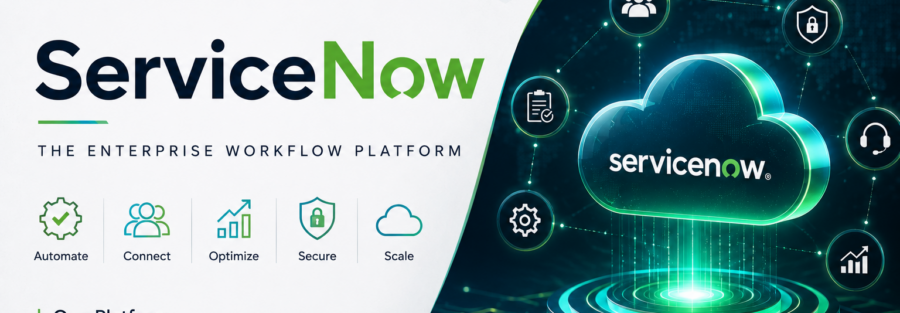
More than just an IT Service Management (ITSM) platform, ServiceNow is a powerful cloud-based workflow platform that helps organisations automate processes, improve productivity, and deliver seamless digital experiences across the enterprise.
What is ServiceNow?
ServiceNow is an enterprise cloud platform designed to automate and digitise workflows across an organisation. It connects people, systems, and processes into a single platform, helping businesses reduce manual effort while increasing operational efficiency.
Today, thousands of organisations worldwide rely on ServiceNow to modernise operations, improve service delivery, and accelerate innovation.
Why Businesses Choose ServiceNow
Modern organisations face several operational challenges, including:
- Manual and repetitive tasks
- Multiple disconnected systems
- Slow approval processes
- Poor visibility into operations
- Inefficient employee experiences
- Increasing security and compliance requirements
ServiceNow addresses these challenges through intelligent workflow automation powered by AI, analytics, and cloud technology.
Key Capabilities of ServiceNow
IT Service Management (ITSM)
ServiceNow simplifies IT operations by automating service requests, incident management, problem management, and change management.
Benefits include:- Faster ticket resolution
- Improved service availability
- Reduced downtime
- Better SLA compliance
- Increased IT productivity
IT Operations Management (ITOM)
Monitor infrastructure, detect issues proactively, and automate operational responses.
Key features include:- Infrastructure monitoring
- Event management
- Discovery
- Cloud management
- Service mapping
- Operational intelligence
Customer Service Management (CSM)
Deliver exceptional customer support through automated workflows and self-service capabilities.
Businesses can:- Resolve customer issues faster
- Reduce response times
- Improve customer satisfaction
- Enable omnichannel support
HR Service Delivery (HRSD)
Simplify HR operations with digital employee experiences.
Common use cases include:- Employee onboarding
- Offboarding
- Leave management
- HR case management
- Employee self-service portal
This reduces administrative work while improving employee satisfaction.
Security Operations (SecOps)
Cybersecurity teams use ServiceNow to automate incident response and vulnerability management.
Capabilities include:- Security incident management
- Threat intelligence
- Vulnerability response
- Risk management
- Compliance workflows
Governance, Risk, and Compliance (GRC)
Maintain compliance while reducing operational risk.
ServiceNow helps organisations:- Manage policies
- Perform audits
- Monitor compliance
- Track business risks
- Automate regulatory reporting
App Engine
Create low-code business applications without extensive development effort.
Organisations can quickly build:- Approval workflows
- Internal business applications
- Request portals
- Custom operational tools
AI Powered Automation
Artificial Intelligence is transforming enterprise operations, and ServiceNow integrates AI throughout the platform.
AI capabilities include:- Intelligent Virtual Agent
- Predictive Intelligence
- AI Search
- Automated routing
- Workflow recommendations
- Document Intelligence
- Generative AI for service agents
These features reduce manual effort while enabling employees to focus on higher-value work.
Benefits of Implementing ServiceNow
Increased Operational Efficiency
Automated workflows eliminate repetitive manual tasks, allowing teams to complete work faster with fewer errors.
Better Employee Experience
Employees can access services through a single portal instead of contacting multiple departments.
This improves productivity while reducing frustration.
Faster Service Delivery
Automated approvals and intelligent routing reduce response times across departments.
Improved Visibility
Real-time dashboards provide complete visibility into business operations, helping leadership make data-driven decisions.
Enhanced Security
Integrated security workflows enable faster incident response while supporting compliance requirements.
Scalability
As organisations grow, ServiceNow scales effortlessly without increasing operational complexity.
Industries Using ServiceNow
ServiceNow supports organisations across multiple industries, including:
- Banking and Financial Services
- Healthcare and Life Sciences
- Manufacturing
- Retail
- Telecommunications
- Energy and Utilities
- Government
- Education
- Technology
- Logistics
Common ServiceNow Use Cases
Businesses use ServiceNow for:
- IT Help Desk Automation
- Employee Service Portal
- Customer Support Automation
- Asset Management
- Change Management
- Incident Management
- Workflow Automation
- Compliance Management
- Project Portfolio Management
- Vendor Management
- Facilities Management
Why ServiceNow Matters in Digital Transformation
Digital transformation is no longer about replacing paper processes with digital forms.
It is about creating connected experiences across the entire organisation.
ServiceNow serves as the digital backbone by integrating departments, automating workflows, and providing a single platform for enterprise operations.
Instead of working in disconnected systems, employees collaborate through unified processes that improve speed, accuracy, and customer satisfaction.
Why Choose ACEIS for ServiceNow Solutions
At ACEIS, we help organisations unlock the full potential of ServiceNow through end-to-end consulting, implementation, integration, and ongoing support.
Our ServiceNow experts work closely with businesses to design solutions that improve efficiency, automate workflows, and accelerate digital transformation.
Our ServiceNow services include:- ServiceNow Consulting
- Platform Implementation
- Custom Workflow Development
- System Integration
- ITSM Implementation
- ITOM Solutions
- HRSD Solutions
- Security Operations
- Platform Optimisation
- Managed Services
- Support and Maintenance
Conclusion
ServiceNow has evolved far beyond traditional IT service management. It has become one of the world’s leading enterprise workflow platforms, enabling organisations to automate operations, enhance employee experiences, strengthen security, and accelerate digital transformation.
Businesses that embrace workflow automation today are better equipped to scale, innovate, and remain competitive in a rapidly changing digital landscape.
If your organisation is looking to streamline operations and maximise business efficiency, ServiceNow provides the platform to make it happen.
Frequently Asked Questions (FAQs)
Is ServiceNow only for IT departments?
No. ServiceNow supports IT, HR, Finance, Security, Customer Service, Operations, Procurement, and many other business functions.
Is ServiceNow cloud-based?
Yes. ServiceNow is a cloud-native SaaS platform that offers scalability, security, and continuous innovation.
Can ServiceNow integrate with existing systems?
Yes. ServiceNow integrates with ERP systems, CRM platforms, cloud services, Microsoft tools, Salesforce, SAP, Oracle, AWS, Azure, and many third-party applications.
Does ServiceNow support AI?
Yes. The platform includes AI-powered capabilities such as Virtual Agent, Predictive Intelligence, AI Search, and Generative AI to automate workflows and improve decision-making.
Why should businesses implement ServiceNow?
ServiceNow helps organisations automate processes, improve efficiency, reduce operational costs, enhance employee experiences, and accelerate digital transformation through a unified workflow platform.