
Financial institutions are under growing pressure to make faster decisions, reduce fraud, improve customer experiences, strengthen compliance, and operate more efficiently. At the same time, banks, insurers, payment providers, and capital markets firms are dealing with enormous volumes of structured and unstructured data spread across legacy systems, cloud platforms, databases, applications, and third-party sources.
This is where Databricks for financial services can play an important role.
Databricks provides a unified data and AI platform that allows financial organisations to bring data engineering, analytics, machine learning, and AI workloads together. Its lakehouse architecture is designed to reduce data silos while providing a common foundation for analytics and AI.
In 2026, the focus is moving beyond experimental AI projects. Financial institutions are increasingly looking at production-grade AI that can support fraud prevention, risk management, customer intelligence, compliance, financial operations, and AI-powered decision-making.
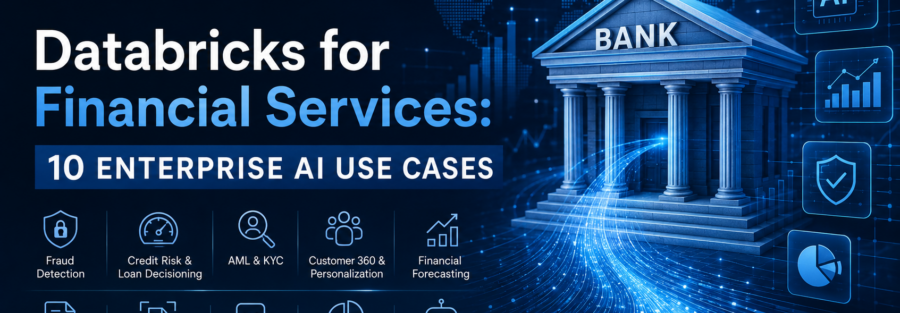
Below are 10 important enterprise AI use cases for financial services.
Why Databricks for Financial Services?
Financial organisations typically manage data from banking transactions, customer profiles, credit systems, payment platforms, market feeds, CRM applications, documents, call recordings, and external sources.
Traditional architectures often separate data warehouses, data lakes, analytics platforms, and machine learning environments. This can create duplicated data, fragmented governance, slow development cycles, and difficulty moving AI models into production.
A lakehouse approach provides a common data foundation for analytics and AI. Databricks describes the lakehouse as combining capabilities associated with data lakes and data warehouses while supporting workloads such as machine learning and business intelligence.
For financial services organizations, this foundation can support use cases such as:
- Real-time fraud detection
- Credit risk assessment
- Anti-money laundering
- Customer 360
- Personalized financial services
- Regulatory compliance
- Document intelligence
- Financial forecasting
- AI-powered customer service
- Enterprise AI agents
1. Real-Time Fraud Detection
Fraud detection is one of the most important Databricks AI use cases in banking.
Financial institutions process massive numbers of transactions across cards, bank accounts, digital wallets, payment gateways, and online banking platforms. Fraud patterns can change rapidly, making static rule-based systems increasingly difficult to maintain.
Databricks can combine transaction data, customer profiles, historical fraud cases, device information, location signals, and other behavioral data to build machine learning models for fraud detection.
A typical architecture can ingest transaction data, transform it, train machine learning models, and deploy those models for real-time inference.
Databricks provides an end-to-end banking fraud demonstration covering data ingestion, governance, analytics, machine learning, model serving, and real-time fraud inference.
Enterprise benefits
- Faster identification of suspicious transactions
- Reduced fraud losses
- Adaptive machine learning models
- Real-time risk scoring
- Better integration of rules and ML
- Centralized fraud data
For example, a transaction can receive a real-time risk score. If the score exceeds a predefined threshold, the institution could trigger additional authentication or route the transaction for human review.
2. Credit Risk and Loan Decisioning
Credit decisioning is another major opportunity for AI in financial services.
Banks need to evaluate customers using information such as credit history, income, transaction behavior, existing obligations, repayment patterns, and other risk indicators.
Databricks can bring these data sources together and support machine learning models that help estimate credit risk.
Instead of relying only on static credit scores, institutions can build models using broader behavioral and transactional information.
A Databricks credit decisioning demonstration shows how customer, credit, and payment data can be ingested and transformed into Delta tables, governed, and used for financial decisioning.
Potential applications
- Loan approval
- Credit limit optimization
- Default prediction
- Early-warning systems
- Customer risk segmentation
- Portfolio risk analysis
AI does not necessarily have to replace human decision-makers. Instead, it can provide risk scores, recommendations, and supporting evidence that help analysts make faster and more informed decisions.
3. Anti-Money Laundering and KYC
Anti-money laundering is particularly challenging because suspicious activity can involve relationships between multiple accounts, customers, businesses, transactions, and jurisdictions.
Databricks can support AML workflows using transaction analytics, machine learning, graph analytics, natural language processing, computer vision, and entity resolution.
Databricks’ AML resources demonstrate approaches including graph analysis, NLP, computer vision, and entity resolution for enterprise-scale AML workflows.
A more recent Databricks example involving TBC Bank demonstrates an AI-powered AML investigation environment that combines sanctions and watchlist searches, document comparison, transaction-purpose analysis, and natural-language analytics.
AI-powered AML applications
- Suspicious transaction detection
- Customer risk scoring
- Entity resolution
- Sanctions screening
- Document verification
- Network analysis
- Investigation assistance
- Automated case summarization
This can help compliance teams move from manually reviewing isolated alerts toward more contextual investigations.
4. Customer 360 and Personalization
Financial institutions have customer information spread across banking products, CRM systems, credit cards, investments, insurance, support interactions, websites, and mobile applications.
Creating a unified Customer 360 view allows financial institutions to understand customers more comprehensively.
Databricks’ 2026 financial services outlook highlights Customer 360 as a strategic capability for personalisation, credit risk management, and agentic workflows.
AI can then use this unified information to identify customer needs and recommend relevant products or services.
Examples
A bank could identify customers who may benefit from:
- A higher savings rate
- A personal loan
- A credit card upgrade
- Investment products
- Insurance
- Wealth management services
The objective is not simply to sell more products. A well-designed personalization system can provide more relevant experiences while improving customer retention and lifetime value.
5. AI-Powered Financial Forecasting
Financial institutions constantly forecast revenue, expenses, liquidity, cash flow, loan demand, deposits, and portfolio performance.
Traditional forecasting models can struggle when market conditions change rapidly.
AI and machine learning can incorporate larger datasets and identify patterns that may not be obvious through conventional reporting.
Databricks can provide a centralized environment where historical financial data, operational information, market signals, and other relevant datasets can be prepared and analyzed.
Applications include
- Revenue forecasting
- Deposit forecasting
- Cash-flow prediction
- Liquidity forecasting
- Loan demand forecasting
- Expense forecasting
- Portfolio performance prediction
Financial teams can also combine predictive models with BI and conversational analytics to make forecasts easier for business users to consume.
6. Regulatory Compliance and Risk Monitoring
Financial institutions operate in highly regulated environments. Compliance teams need to monitor transactions, customers, communications, models, and operational processes while maintaining evidence for audits.
AI can help automate parts of this workflow.
Databricks emphasizes governed AI and data environments for financial services, including explainability, auditability, security, and regulatory controls.
Potential applications include:
- Regulatory document analysis
- Policy monitoring
- Compliance reporting
- Risk identification
- Transaction monitoring
- Regulatory change analysis
- Audit preparation
- Compliance case summarization
Generative AI can also help compliance teams search large document collections using natural language and summarize relevant information.
However, financial institutions should maintain appropriate human review and governance for high-impact compliance decisions.
7. Intelligent Document Processing
Banks and financial institutions process enormous amounts of documents.
These may include:
- Loan applications
- Invoices
- Contracts
- Tax documents
- Identity documents
- Insurance claims
- Financial statements
- Regulatory documents
Generative AI and document intelligence can extract information from these documents and convert unstructured information into usable data.
For example, an AI workflow could extract financial information from a company’s documents and make it available to a credit analyst.
Databricks’ financial-services examples also demonstrate AI analysis of documents such as invoices, contracts, and customs documents in AML investigations.
Business benefits
- Reduced manual data entry
- Faster document processing
- Improved information retrieval
- Lower operational costs
- Better access to unstructured data
8. AI-Powered Customer Service
Customer service is another area where financial institutions can benefit from generative AI.
Instead of forcing customers or employees to search through multiple systems, AI assistants can provide conversational access to approved enterprise information.
For example, an internal banking assistant could help an employee answer questions about:
- Customer accounts
- Product information
- Internal policies
- Service procedures
- Transaction history
- Compliance requirements
Databricks is positioning conversational intelligence and governed AI experiences as part of its financial services strategy, including natural-language interaction with enterprise data.
The key requirement is that these systems must operate using trusted, governed data rather than generating unsupported answers.
9. Wealth Management and Investment Intelligence
AI can also support wealth management and investment teams.
Financial institutions can combine customer information, portfolio data, market information, research, and historical performance to create intelligent investment workflows.
Possible applications include:
- Portfolio analysis
- Client segmentation
- Investment research
- Risk profiling
- Market intelligence
- Portfolio monitoring
- Personalized financial insights
Generative AI can make large amounts of investment research easier to search and summarize, while traditional machine learning models can support forecasting and risk analysis.
For enterprise deployment, governance remains critical because investment recommendations can have significant financial consequences.
10. Agentic AI for Financial Workflows
One of the biggest emerging trends is the movement from AI assistants toward agentic AI.
Instead of simply answering questions, AI agents can potentially perform multi-step workflows using approved tools and enterprise data.
For example, an AI agent could:
- Receive a customer request.
- Retrieve relevant customer information.
- Check applicable policies.
- Analyze transaction history.
- Identify potential risks.
- Generate a recommendation.
- Request human approval when required.
- Record the decision and supporting information.
Databricks’ current financial-services strategy places significant emphasis on enterprise AI agents and governed agentic workflows.
This could eventually transform workflows across banking, insurance, payments, wealth management, and capital markets.
However, financial institutions should design agentic systems with strict permissions, auditability, human oversight, and clear boundaries around autonomous actions.
How Databricks Enables Enterprise AI in Financial Services
The value of Databricks is not simply the ability to train an AI model.
The bigger opportunity is creating an integrated data and AI foundation.
A typical enterprise architecture can include:
Data Sources → Data Engineering → Lakehouse → Governance → Analytics → ML/AI → Model Serving → Business Applications
Financial data can originate from core banking systems, payment platforms, CRM systems, databases, APIs, market feeds, applications, and external sources.
Databricks can then provide a common environment for processing, analytics, machine learning, and AI.
Governance is particularly important for financial services. Databricks provides capabilities around access controls, lineage, auditing, and data governance through its platform. Its financial-services examples also highlight fine-grained access controls, lineage, PII protection, audit logs, and data sharing.
Databricks also provides compliance-related security capabilities. Its compliance security profile supports additional controls for regulated workloads, with support for standards including PCI-DSS and other frameworks depending on configuration and workload.
Key Benefits of Databricks for Financial Services
When implemented correctly, an enterprise Databricks platform can help financial organizations achieve several strategic benefits.
1. Unified Data Foundation
Organizations can reduce fragmentation by bringing multiple data workloads onto a common platform.
2. Faster AI Development
Data engineers, analysts, and data scientists can work from shared data rather than repeatedly moving and copying datasets.
3. Real-Time Decisioning
Streaming data and real-time inference can support use cases such as fraud detection and transaction monitoring.
4. Stronger Governance
Centralized governance can help organizations control access, track lineage, and support audit requirements.
5. Scalable AI
Financial institutions can move AI projects from experimentation toward production-scale deployment.
6. Better Business Intelligence
Business users can combine traditional BI with AI-powered analytics and conversational experiences.
Challenges Financial Institutions Should Consider
Despite the potential benefits, implementing enterprise AI in financial services is not simply a technology upgrade.
Organizations need to address several challenges.
Data Quality
AI models are only as reliable as the data used to train and operate them. Financial institutions need strong data quality, validation, metadata, and lineage processes.
Security and Privacy
Financial data can contain highly sensitive information. Access controls, encryption, monitoring, and privacy protections need to be incorporated into the architecture.
Model Risk
Financial institutions should validate models carefully, monitor model performance, and maintain appropriate documentation and governance.
Explainability
For high-impact financial decisions, organizations may need to explain how models reached their outputs.
Human Oversight
AI should not automatically make every financial decision. Human review may remain necessary for high-risk transactions, lending decisions, compliance cases, and other sensitive workflows.
The Future of AI in Financial Services
The next stage of financial-services AI will likely be less about isolated models and more about integrated intelligence.
Financial institutions are moving toward architectures where data, analytics, machine learning, generative AI, and agents operate on a shared foundation.
Databricks’ 2026 financial-services outlook identifies several strategic directions, including AI-powered fraud detection, Customer 360, early-warning systems, AI-augmented finance teams, personalization, and preparation for AI agents.
The organizations that benefit most will not necessarily be those that deploy the largest number of AI models. They will be the organizations that can connect high-quality data with governed AI and embed those capabilities into real business workflows.
Conclusion
Databricks for financial services represents more than a modern data platform. It can provide a foundation for building enterprise AI applications across banking, payments, insurance, wealth management, and capital markets.
The 10 use cases discussed in this article demonstrate the breadth of the opportunity:
- Real-time fraud detection
- Credit risk and loan decisioning
- Anti-money laundering and KYC
- Customer 360 and personalization
- Financial forecasting
- Regulatory compliance and risk monitoring
- Intelligent document processing
- AI-powered customer service
- Wealth management and investment intelligence
- Agentic AI for financial workflows
The key to success is combining AI innovation with strong data engineering, governance, security, and human oversight.
For financial institutions, the competitive advantage will increasingly come from turning trusted enterprise data into intelligent, measurable, and production-ready business outcomes.
Frequently Asked Questions
What is Databricks used for in financial services?
Databricks can be used for data engineering, analytics, machine learning, generative AI, fraud detection, risk management, AML, customer intelligence, forecasting, and AI-powered business workflows.
Is Databricks suitable for banking?
Yes. Databricks provides capabilities designed for enterprise data and AI workloads, and its financial-services resources include banking use cases such as fraud detection, credit decisioning, AML, Customer 360, and agentic AI.
Can Databricks perform real-time fraud detection?
Yes. Databricks provides a retail banking fraud demonstration covering streaming/data ingestion, machine learning, model serving, and real-time fraud inference.
Can Databricks support AML and KYC?
Yes. Databricks provides AML resources and solution approaches involving transaction analysis, graph analytics, entity resolution, NLP, computer vision, and AI-assisted investigations.
Why is governance important for financial-services AI?
Financial institutions deal with sensitive data and regulated decisions. Governance helps organizations control data access, maintain lineage, monitor activity, support audits, and establish appropriate controls around AI systems.
What is the biggest opportunity for Databricks in financial services?
The biggest opportunity is moving from disconnected analytics and AI experiments toward a unified, governed data and AI platform that can support real-time decisioning, intelligent workflows, and enterprise AI agents at scale.