
Retail has always been driven by data. Every purchase, website visit, customer interaction, inventory movement, and supply-chain activity creates valuable information. But today, retailers face a bigger challenge than simply collecting data: how do they bring all that data together and turn it into meaningful business decisions?
This is where Databricks can make a significant difference.
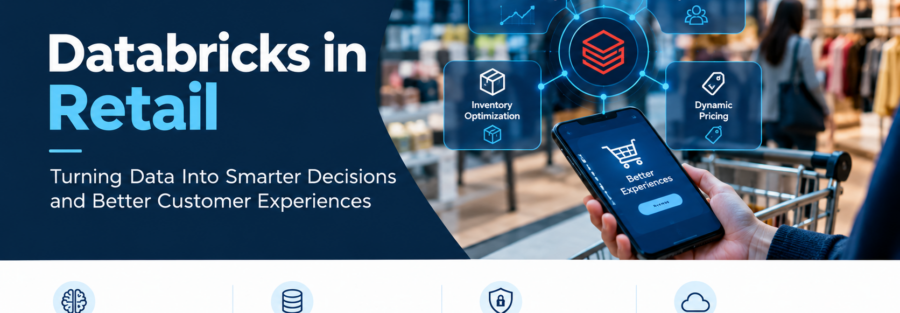
By bringing data engineering, analytics, machine learning, and AI together, Databricks can help retailers transform fragmented data into actionable insights. From personalized customer experiences and demand forecasting to dynamic pricing and fraud detection, data can become a powerful engine for retail growth.
Why Data Matters More Than Ever in Retail
Modern retailers generate data from countless sources. Point-of-sale systems capture transactions, e-commerce platforms record online behavior, CRM systems store customer information, and supply-chain platforms track products and inventory.
Retailers may also use external data such as market trends, demographics, weather, or competitor information.
The challenge is that this information is often spread across different systems.
When data remains disconnected, retailers may struggle to answer basic but important questions:
- What are customers buying?
- Why are they buying it?
- Which products are likely to become popular?
- How much inventory should each store carry?
- Which customers are most likely to purchase again?
- Where are operational costs increasing?
Databricks can help bring these different data sources together, creating a stronger foundation for analytics and AI.
The result is a shift from simply having data to actually using data to make better decisions.
1. Customer 360 and Personalization
Today’s customers expect brands to understand their needs.
Imagine a customer who browses running shoes online, purchases sportswear from a physical store, and regularly buys fitness accessories. If this information exists in separate systems, the retailer sees only fragments of the customer’s journey.
By bringing these interactions together, retailers can create a 360-degree view of the customer.
This can support more personalized recommendations, promotions, and experiences.
For example, instead of sending a generic promotion to every customer, a retailer could recommend products based on previous purchases, browsing behavior, preferences, and engagement.
Personalization can help retailers improve customer engagement, increase conversion opportunities, and build stronger customer relationships.
2. Demand Forecasting and Inventory Optimization
One of retail’s biggest challenges is having the right product available at the right time.
Too little inventory can result in lost sales and disappointed customers. Too much inventory can tie up capital and eventually lead to markdowns or waste.
Databricks can help retailers analyze historical sales, customer behavior, seasonality, promotions, inventory levels, and other signals to improve demand forecasting.
Instead of asking only, “What did we sell last year?”, retailers can begin asking:
“What are customers likely to buy next?”
More accurate forecasting can help businesses reduce stockouts, minimize excess inventory, improve supply-chain planning, and make better purchasing decisions.
3. Dynamic Pricing
Pricing is another area where data and AI can create significant value.
Retail conditions can change quickly. Customer demand fluctuates, inventory levels change, competitors adjust their prices, and promotions influence purchasing behavior.
With real-time data and analytics, retailers can develop more responsive pricing strategies.
For example, a retailer can consider demand, inventory availability, competitor pricing, and sales trends when determining the most appropriate price for a product.
The objective isn’t simply to charge more. It is about finding the right balance between customer value, demand, inventory, and profitability.
4. Fraud Detection and Risk Management
Retailers process millions of transactions, creating significant opportunities for fraud and financial risk.
Traditional rules can identify some suspicious activity, but sophisticated fraud can be difficult to detect when patterns constantly change.
Machine learning can help identify unusual transaction patterns and behaviors across large volumes of data.
For example, a retailer might identify a transaction that significantly differs from a customer’s typical purchasing behavior and flag it for investigation.
Better analytics can help retailers detect suspicious activity, reduce potential losses, strengthen risk management, and improve compliance.
5. Store and Operations Analytics
Retail success isn’t only about selling products. It is also about running stores efficiently.
Retailers can use data to understand store performance, customer traffic, staffing requirements, inventory levels, and operational costs.
For example, if customer traffic consistently increases during specific hours, managers can use that information to optimize staff scheduling.
Similarly, comparing performance across stores can help identify locations that are performing exceptionally well or those that may require additional attention.
When small operational improvements are applied across hundreds or thousands of stores, the overall business impact can be substantial.
Bringing Analytics and AI Together
The real power of Databricks comes from bringing different capabilities together.
Advanced analytics helps retailers understand what is happening.
Machine learning can help predict what may happen next.
Generative AI can help employees interact with information and generate useful insights.
Real-time processing enables businesses to respond more quickly as new data becomes available.
Together, these capabilities can create a continuous journey:
Retail Data → Databricks → Analytics & AI → Insights → Better Decisions → Business Value
This is what makes a data platform valuable—not simply storing information, but helping organizations act on it.
The Future of Data-Driven Retail
Retailers are no longer competing only on products and prices. They are competing on customer experience, speed, efficiency, personalization, and the ability to respond to changing market conditions.
Databricks can provide a foundation for connecting data across the retail ecosystem and applying analytics and AI to some of the industry’s most important challenges.
Whether the goal is improving customer personalization, forecasting demand, optimizing inventory, detecting fraud, improving store operations, or identifying new growth opportunities, the underlying principle remains the same:
Better data can lead to better decisions.
And better decisions can lead to happier customers, higher sales, lower costs, and sustainable growth.
The future of retail isn’t simply about collecting more data.
It’s about turning data into intelligence—and intelligence into action.