

How REST APIs Work in ServiceNow
Introduction
In today’s digital world, organisations employ a variety of tools and platforms to manage various business processes. ERP systems manage funds, CRM platforms handle customers, monitoring tools track infrastructure, and HR systems maintain employee records. The problem occurs when these systems have to communicate with one another.
ServiceNow has robust REST API capabilities that allow external systems to communicate with the ServiceNow platform. Without the need for human involvement, REST APIs enable standardised information sharing across systems.
What is REST API?
Representational State Transfer is referred to as REST.
A web service architecture known as a REST API enables apps to exchange data, usually in JSON or XML format, and communicate over HTTP protocols.
REST APIs function as intermediaries between systems.
For instance:
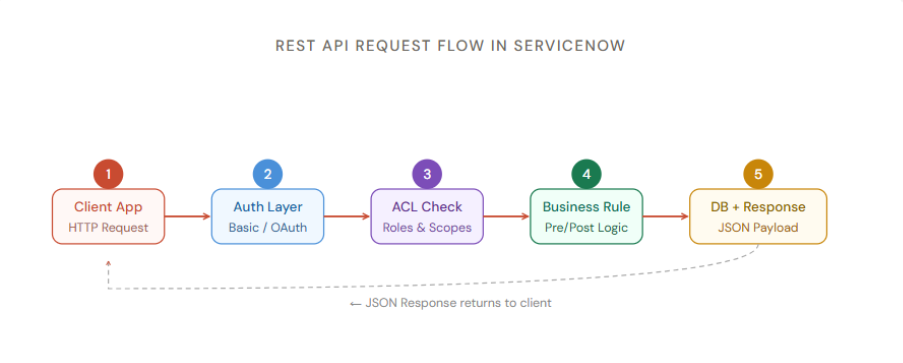
A request is made through a portal by an employee.
The request is received by ServiceNow.
Other application receives data from ServiceNow.
It is processed by the remote application.
A reply is returned.
This procedure is automated with REST APIs.
Why REST APIs are Important in ServiceNow?

- Integrating External Applications – SAP, Salesforce, JIRA, Azure
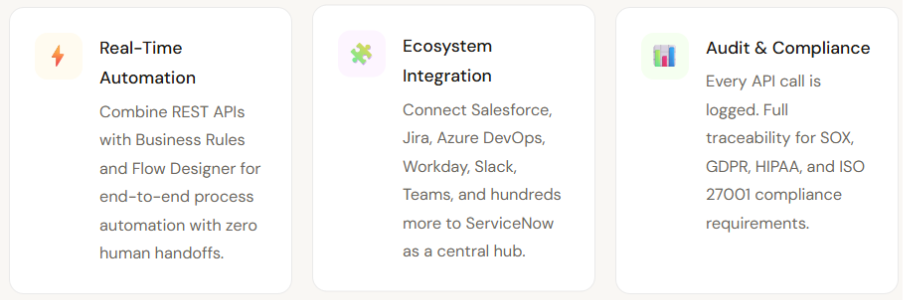
- Automating Workflows – Instead of manually creating records -> external applications can automatically create incidents, update incidents, trigger approvals
- Data synchronization – REST APIs help -> Employee data in HR software automatically updates in servicenow
- Real-time Communication – Monitoring tools can immediately create incidents when servers fail
- Reduce Human Errors –
How REST APIs Transform Real Enterprises
1. IT – Zero-Touch Incident Creation (Incident Automation)
A server outage is detected by a hospital’s monitoring system. An instantaneous REST API call from the monitoring tool to ServiceNow creates a P1 issue, assigns it to the on-call team, and sends out SMS alerts in place of someone manually logging a ticket. Without the need for a human, all in a matter of seconds.
2. Financial Institution – Live Asset Intelligence (CMDB Synchronization)
A big bank uses AWS CloudWatch and ServiceNow REST APIs to automatically update their CMDB when a new EC2 instance is created. Each asset is tracked in real time, allowing for accurate effect assessments during outages. Compliance teams adore it.
3. Retailer – Automated HR-to-IT Handoff (Employee Onboarding)
When HR accepts a new hiring in Workday, a webhook sends a REST API call to ServiceNow, which automatically generates a catalogue request for a laptop, Active Directory account, and email setup – all before the employee’s first day.
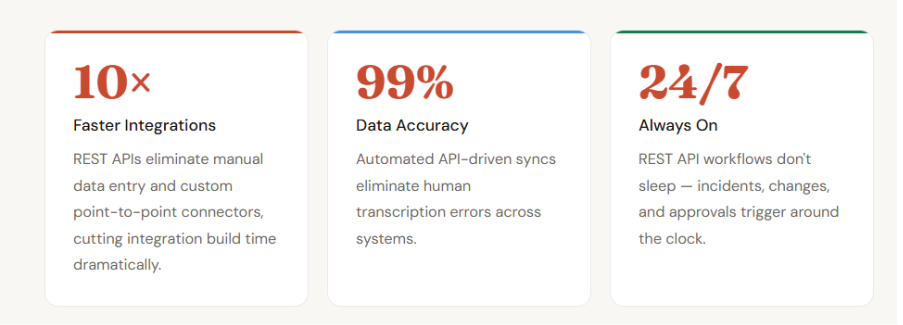
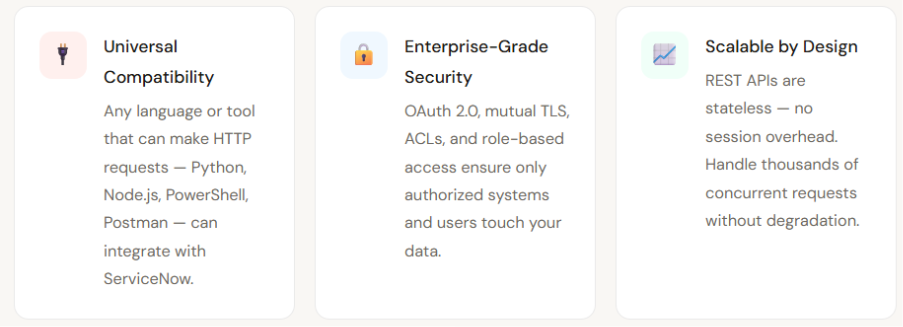
Business Benefits of ServiceNow REST APIs
Difference b/w REST APIs vs Without REST APIs
| Without REST APIs | REST APIs |
| Manually copy-paste data between Jira and ServiceNow | Bi-directional sync happens automatically on every update |
| Email chains to trigger provisioning workflows | POST request creates and routes the task in milliseconds |
| Hours with REST API — standard HTTP, documented, tested | Monitoring auto-creates incident + pages the right team |
| Separate dashboards for each tool; context switching all day | Unified view pulling live ServiceNow data into any portal |
| Nightly batch jobs to update CMDB data | Real-time CMDB updates via event-driven API calls |
Final Thoughts
ServiceNow REST APIs close this gap by allowing for safe, real-time, and automatic data transmission between systems. REST APIs assist remove manual processes and improve operational efficiency by automatically producing incidents based on monitoring alarms, synchronising staff onboarding activities, integrating chatbots, and connecting AI-powered recommendation engines.
REST APIs are no longer merely integration tools as organisations strive for intelligent and autonomous operations; they are strategic facilitators of digital transformation. Understanding how REST APIs function in ServiceNow enables developers and administrators to create scalable, dependable, and future-ready solutions.
The future of enterprise workflows lies in connected ecosystems where applications communicate effortlessly, and REST APIs serve as the foundation that makes this possible.
“Mastering REST APIs in ServiceNow is not only about learning how systems exchange data—it is about building smarter, faster, and more connected business solutions.”