
10 Powerful Databricks Use Cases Every Enterprise Should Know in 2026
As businesses continue to embrace Artificial Intelligence (AI), Big Data Analytics, and Cloud Data Platforms, the demand for scalable, unified data solutions has never been higher. Organizations need a platform that can manage massive datasets, enable real-time analytics, accelerate machine learning, and simplify data governance.
That’s where Databricks stands out.
Built on the modern Lakehouse Architecture, Databricks combines Data Engineering, Data Warehousing, Machine Learning, Business Intelligence, and Generative AI into one unified platform. This enables organizations to eliminate data silos, accelerate innovation, and drive smarter business decisions.
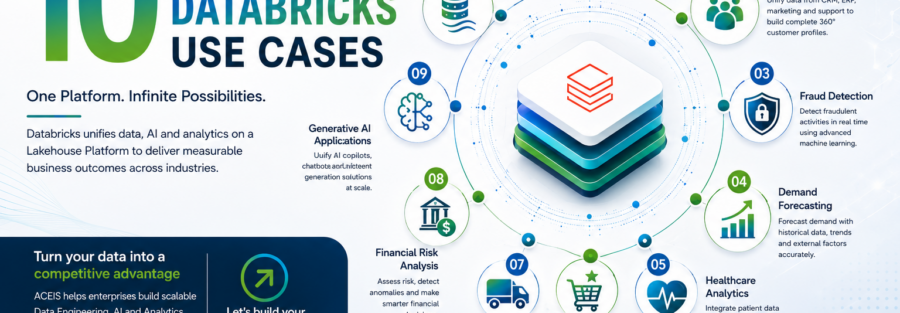
In this article, we’ll explore 10 powerful Databricks use cases that are helping enterprises modernize their data infrastructure and unlock new business opportunities.
1. Predictive Maintenance
Unexpected equipment failures can lead to costly downtime and operational disruptions. Databricks enables manufacturers to analyze IoT sensor data in real time and identify potential equipment failures before they occur.
By applying Machine Learning models to telemetry data, organizations can schedule maintenance proactively instead of reacting to failures.
Benefits
- Reduce equipment downtime
- Lower maintenance costs
- Increase asset lifespan
- Improve production efficiency
Industries
Manufacturing, Automotive, Oil & Gas, Energy, Utilities
2. Customer 360
Customer data often exists across multiple systems such as CRM, ERP, websites, support platforms, and marketing tools. Databricks helps organizations unify these data sources to create a complete Customer 360 view.
With a single customer profile, businesses can deliver personalized experiences, improve customer engagement, and make data-driven decisions.
Benefits
- Personalized marketing campaigns
- Better customer segmentation
- Improved customer support
- Higher customer retention
Industries
Retail, Banking, Healthcare, Telecommunications, E-commerce
3. Fraud Detection
Financial fraud continues to evolve, making traditional detection methods less effective. Databricks uses Real-Time Analytics and Machine Learning to detect suspicious transactions as they happen.
Streaming analytics combined with AI models enables organizations to respond instantly to fraudulent activities while reducing false positives.
Benefits
- Detect fraud in real time
- Reduce financial losses
- Improve compliance
- Enhance customer trust
Industries
Banking, FinTech, Insurance, Payments
4. Demand Forecasting
Accurate demand forecasting helps organizations optimize inventory, reduce waste, and improve supply chain efficiency.
Databricks analyzes historical sales data, seasonal trends, customer behavior, and external market factors to generate highly accurate demand forecasts.
Benefits
- Better inventory planning
- Reduce stock shortages
- Optimize warehouse operations
- Improve customer satisfaction
Industries
Retail, Manufacturing, Consumer Goods, Logistics
5. Healthcare Analytics
Healthcare organizations generate enormous volumes of patient data every day. Databricks enables hospitals and healthcare providers to combine electronic health records, medical imaging, laboratory reports, and wearable device data into one unified platform.
This allows healthcare professionals to generate AI-driven insights that improve patient care and operational efficiency.
Benefits
- Faster diagnosis
- Better patient outcomes
- Predictive healthcare analytics
- Improved resource planning
Industries
Healthcare, Pharmaceuticals, Life Sciences
6. Recommendation Engines
Modern customers expect personalized experiences. Databricks helps organizations build intelligent recommendation systems using Machine Learning and behavioral analytics.
Recommendation engines analyze customer preferences, browsing history, and purchasing patterns to suggest the most relevant products or content.
Benefits
- Increase sales
- Improve customer engagement
- Higher conversion rates
- Better user experience
Industries
E-commerce, Streaming Platforms, Retail, Travel
7. Supply Chain Optimization
Managing global supply chains requires real-time visibility across suppliers, warehouses, transportation, and inventory.
Databricks helps organizations optimize logistics by analyzing large-scale operational data and identifying inefficiencies.
Benefits
- Reduce logistics costs
- Improve inventory management
- Faster deliveries
- Better supplier collaboration
Industries
Manufacturing, Logistics, Retail, Automotive
8. Financial Risk Analysis
Financial institutions rely on accurate risk analysis for lending, investments, and regulatory compliance.
Databricks enables organizations to process millions of financial records and identify anomalies using advanced analytics and AI models.
Benefits
- Better risk assessment
- Smarter investment decisions
- Faster financial reporting
- Regulatory compliance
Industries
Banking, Insurance, Investment Firms
9. Generative AI Applications
Generative AI is transforming how organizations interact with data and customers. Databricks enables enterprises to develop secure AI-powered applications using Large Language Models (LLMs) and enterprise data.
Common applications include AI chatbots, virtual assistants, document intelligence, and enterprise knowledge management systems.
Benefits
- Faster customer support
- AI-powered automation
- Increased employee productivity
- Secure enterprise AI
Industries
Technology, Healthcare, Finance, Retail, Customer Support
10. Data Lakehouse Modernization
Traditional data warehouses often struggle with scalability and flexibility. Databricks simplifies data management through its Lakehouse Architecture, combining the best capabilities of data lakes and data warehouses.
Organizations can centralize structured and unstructured data while improving performance, governance, and collaboration.
Benefits
- Unified analytics platform
- Lower infrastructure costs
- Faster data processing
- Enterprise scalability
Industries
All Industries
Why Enterprises Choose Databricks
Organizations worldwide trust Databricks because it offers a unified platform for modern data and AI workloads.
Key advantages include:
- Unified Lakehouse Architecture
- Enterprise Data Engineering
- Machine Learning & AI
- Real-Time Analytics
- Cloud-Native Platform
- High-Performance SQL Analytics
- Secure Data Governance
- Scalable Infrastructure
- Collaboration Across Data Teams
How ACEIS Can Help
As a Databricks Registered Partner, ACEIS helps organizations build modern, scalable, and secure data platforms that accelerate digital transformation.
Our Databricks services include:
- Databricks Consulting
- Data Engineering
- Lakehouse Implementation
- AI & Machine Learning Solutions
- Data Modernization
- Real-Time Analytics
- Cloud Migration
- Enterprise Data Governance
- Business Intelligence Solutions
- Generative AI Development
Whether you’re modernizing legacy systems or building next-generation AI applications, our experts can help you maximize the value of your data.
Conclusion
The future of enterprise innovation depends on how effectively organizations leverage their data. From Predictive Maintenance and Customer 360 to Generative AI Applications and Data Lakehouse Modernization, Databricks empowers businesses to turn data into a competitive advantage.
Organizations that invest in a modern Data Lakehouse Platform today will be better equipped to innovate, improve operational efficiency, reduce costs, and accelerate AI adoption.
If you’re planning your next data transformation initiative, Databricks provides the scalability, intelligence, and flexibility needed to succeed.
Frequently Asked Questions (FAQs)
What is Databricks used for?
Databricks is a unified data platform used for data engineering, machine learning, AI, business intelligence, real-time analytics, and data warehousing.
Which industries benefit from Databricks?
Healthcare, banking, manufacturing, retail, logistics, telecommunications, insurance, energy, and public sector organizations all benefit from Databricks.
Is Databricks suitable for AI applications?
Yes. Databricks supports Machine Learning, Generative AI, Large Language Models (LLMs), and enterprise AI development on a unified platform.
Why is Databricks popular?
Its Lakehouse Architecture, scalability, cloud-native design, AI capabilities, and unified analytics make it one of the leading enterprise data platforms.