
What is Arize AI? The Platform Fixing How AI Works in the Real World
As LLMs and AI agents go mainstream, one question haunts every engineering team: How do we know if our AI is actually working? Arize AI was built to answer exactly that.
The core idea: AI needs a watchdog
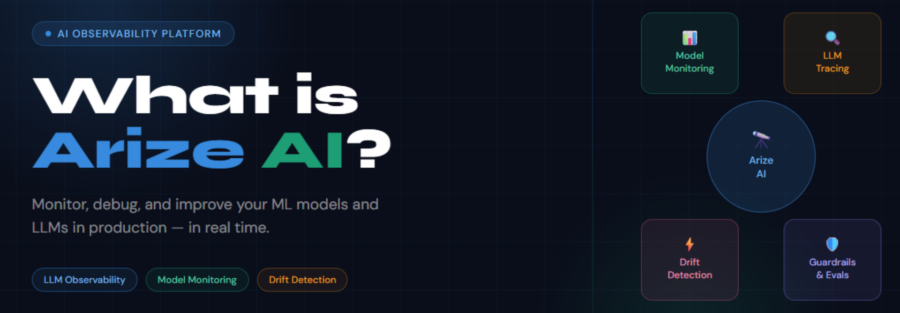
Arize AI is an AI observability and evaluation platform that helps companies track, debug, and improve their AI models and applications. Think of it as the Datadog or Dynatrace for AI systems — but purpose-built for machine learning, generative AI, and autonomous agents.
Founded in 2020 by Aparna Dhinakaran and Jason Lopatecki in Berkeley, California, Arize started with predictive ML. The explosion of LLMs and AI agents has pushed it to the center of the modern AI stack. Today it works across computer vision, generative AI, RAG pipelines, and multi-agent systems.
What does Arize AI actually do?
Arize sits between your AI model and the real world. It evaluates your AI before you ship and monitors it after — catching hallucinations, performance drift, bias, and broken outputs before users notice.
- 1 Pre-launch evaluation — Test your LLM or AI agent on curated datasets before going live. Arize uses a “council of judges” approach: evaluating AI output with multiple AI models plus human reviewers.
- 2 Real-time monitoring — Once live, Arize watches every inference for data drift, response quality degradation, latency spikes, and unexpected behavior.
- 3 RAG & agent tracing — For teams building Retrieval-Augmented Generation apps or multi-step AI agents, Arize traces every step of the pipeline so you can pinpoint exactly where things went wrong.
- 4 Arize Phoenix (open source) — A free, open-source version developers can run locally. Over 2 million monthly downloads make it one of the most popular AI observability tools available.
Who uses Arize AI?
Arize works with enterprise teams that have gone beyond experimentation and are running AI in production at scale.
Microsoft has collaborated with Arize to help enterprises deploy generative AI more effectively — a strong signal of the platform’s credibility in the enterprise AI space.
Key use cases Trending in 2026
How is Arize AI different from competitors?
The AI observability space is filling up fast — Galileo, Patronus AI, Langfuse, and others are competing for the same market. Arize’s edge comes from three things: it covers both pre-launch evaluation and post-launch monitoring in a single platform, it works across virtually every AI application type (ML, GenAI, agents, vision), and it has the open-source traction of Arize Phoenix as a developer trust-builder.
With a $70M Series C closed in early 2025 and investors including Microsoft’s M12 and Adams Street Partners, Arize has the runway to stay ahead of the pack.
Should you use Arize AI?
If your team is shipping AI to real users — whether it’s a customer-facing chatbot, a RAG-powered search, or an autonomous agent — the answer is almost certainly yes. Flying blind in production is how hallucinations become user incidents. Arize gives engineering and ML teams the visibility to catch issues early, iterate faster, and build AI products that actually work reliably.
For individuals and small teams, Arize Phoenix (open source) is a great no-cost starting point. For enterprises, the full Arize platform integrates deeply with your existing ML infrastructure and cloud stack.
Bottom line
Arize AI is the observability layer the AI industry has been missing. As LLMs, RAG apps, and AI agents move from demos to production, platforms like Arize are shifting from “nice to have” to mission-critical infrastructure for any serious AI team.