
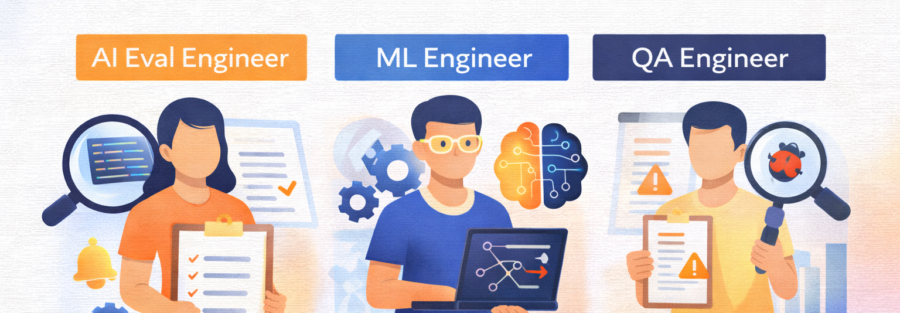
AI Eval Engineer vs ML Engineer vs QA Engineer: Understanding the Key Differences in Modern AI Teams
Artificial Intelligence is no longer just an experimental technology. Today, AI systems are powering real products, influencing decisions, and interacting directly with users. As a result, AI teams are evolving, and so are the roles within them.
Three roles often come up in discussions around AI development and quality:
- AI Eval Engineer
- ML Engineer
- QA Engineer
While they may sound similar, their responsibilities, impact, and value are very different. Understanding these differences is crucial for companies building AI products and for professionals planning their careers in AI.
What Is an ML Engineer?
A Machine Learning Engineer (ML Engineer) is responsible for building and training machine learning models.
Their core focus includes:
- Developing ML models and pipelines
- Training models on large datasets
- Optimizing algorithms and performance
- Deploying models into production
ML Engineers answer the question:
“Can we build a model that performs well on the data?”
They work deeply with:
- Training data
- Model architectures
- Performance metrics like accuracy and loss
Without ML Engineers, there is no intelligence to begin with.
What Is a QA Engineer?
A Quality Assurance (QA) Engineer ensures that software works as expected.
In traditional software systems, QA Engineers:
- Test features and workflows
- Identify bugs and edge cases
- Ensure stability before release
- Validate user experience
QA Engineers answer the question:
“Does the system behave as designed?”
However, AI systems behave differently from traditional software. Outputs are probabilistic, not fixed. This makes AI harder to test using conventional QA methods alone.
What Is an AI Eval Engineer?
An AI Eval Engineer (AI Evaluation Engineer) focuses on evaluating how AI systems behave in the real world.
Instead of building models, they design systems to measure trust, safety, and reliability.
AI Eval Engineers focus on:
- Evaluating model correctness and reasoning
- Detecting hallucinations and failures
- Measuring bias, toxicity, and safety risks
- Monitoring model drift and regressions
- Comparing model versions over time
They answer the hardest question in AI:
“Can we trust this AI system at scale?”
This role has become increasingly important with the rise of:
- Large Language Models (LLMs)
- Generative AI
- Autonomous AI agents
- AI copilots used in real products
AI Eval Engineer vs ML Engineer vs QA Engineer (Quick Comparison)
ML Engineer
- Builds and trains AI models
- Focuses on performance and optimization
- Goal: create intelligent systems
QA Engineer
- Tests software functionality
- Focuses on bugs and stability
- Goal: ensure features work correctly
AI Eval Engineer
- Evaluates AI behavior in real-world scenarios
- Focuses on safety, reliability, and trust
- Goal: ensure AI works for the right reasons
In modern AI teams, these roles are complementary, not competing.
Why AI Eval Engineers Are Becoming Critical
As AI systems become more autonomous and human-facing, small errors can lead to serious consequences. Hallucinations, bias, or silent failures can damage trust, cause legal issues, and impact business outcomes.
AI Eval Engineers help organizations:
- Reduce AI-related risks
- Improve user trust and adoption
- Support responsible AI practices
- Meet governance and compliance requirements
- Ship AI products with confidence
This is why job titles like AI Eval Engineer, LLM Evaluation Engineer, and AI Quality Engineer are trending across AI-first companies.
Which Role Is Right for You?
- Choose ML Engineer if you enjoy building models and working with data and algorithms
- Choose QA Engineer if you enjoy testing systems and improving reliability
- Choose AI Eval Engineer if you enjoy analyzing AI behavior, designing evaluation frameworks, and ensuring trustworthy AI
As AI continues to evolve, teams that invest in strong evaluation will have a major advantage.
Final Thoughts
The future of AI isn’t just about smarter models. It’s about reliable, safe, and trustworthy systems.
ML Engineers build intelligence.
QA Engineers protect functionality.
AI Eval Engineers protect trust.
In the next phase of AI adoption, that trust may be the most valuable asset of all.