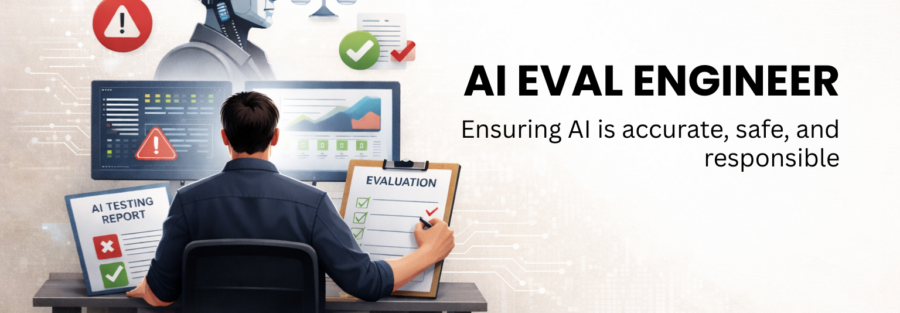
In 2026, one of the most impactful roles in AI teams won’t be a developer, a data scientist, or even a product manager.
It will be the person responsible for deciding whether the AI we build is actually acceptable, not just functional.
Enter the Eval Engineer. 🚀
As AI systems move from prototype to production, we’re discovering something important: traditional testing isn’t enough. AI doesn’t behave like software that fails loudly with errors. It can look right even when it’s wrong, misleading, or unsafe.
That’s where eval engineering comes in, a discipline that sits at the intersection of data science, software engineering, and quality assurance. It’s all about:
🔹 Defining meaningful measurements for AI quality, beyond simple accuracy, like context adherence, safety, hallucination rates, instruction alignment, and more.
🔹 Creating and tuning evals that act as both tests during development and guardrails in production.
🔹 Monitoring AI in production, spotting drift, failures, and edge cases as they emerge from real user traffic.
🔹 Feeding learnings back into the development cycle so models get better over time.
In other words, Eval Engineers ensure AI isn’t just shipped; it’s trusted. They build the frameworks that answer tough questions like:
✔️ Is the AI behaving responsibly and predictably?
✔️ Does it meet our quality and safety standards at real scale?
✔️ Are regressions caught before they impact users?
Without systematic evaluation and continuous feedback loops, teams will always be in reactive mode, chasing bugs after users complain. With strong eval engineering, quality becomes visible, measurable, and governable.
If you’re building GenAI systems that matter, in enterprise, healthcare, finance, or consumer products, this role won’t be optional. It will be foundational.
Here’s to the rise of Eval Engineers 👏